

Quantum-Resistant Encryption: Why 2025 Is the Year to Act

TL;DR
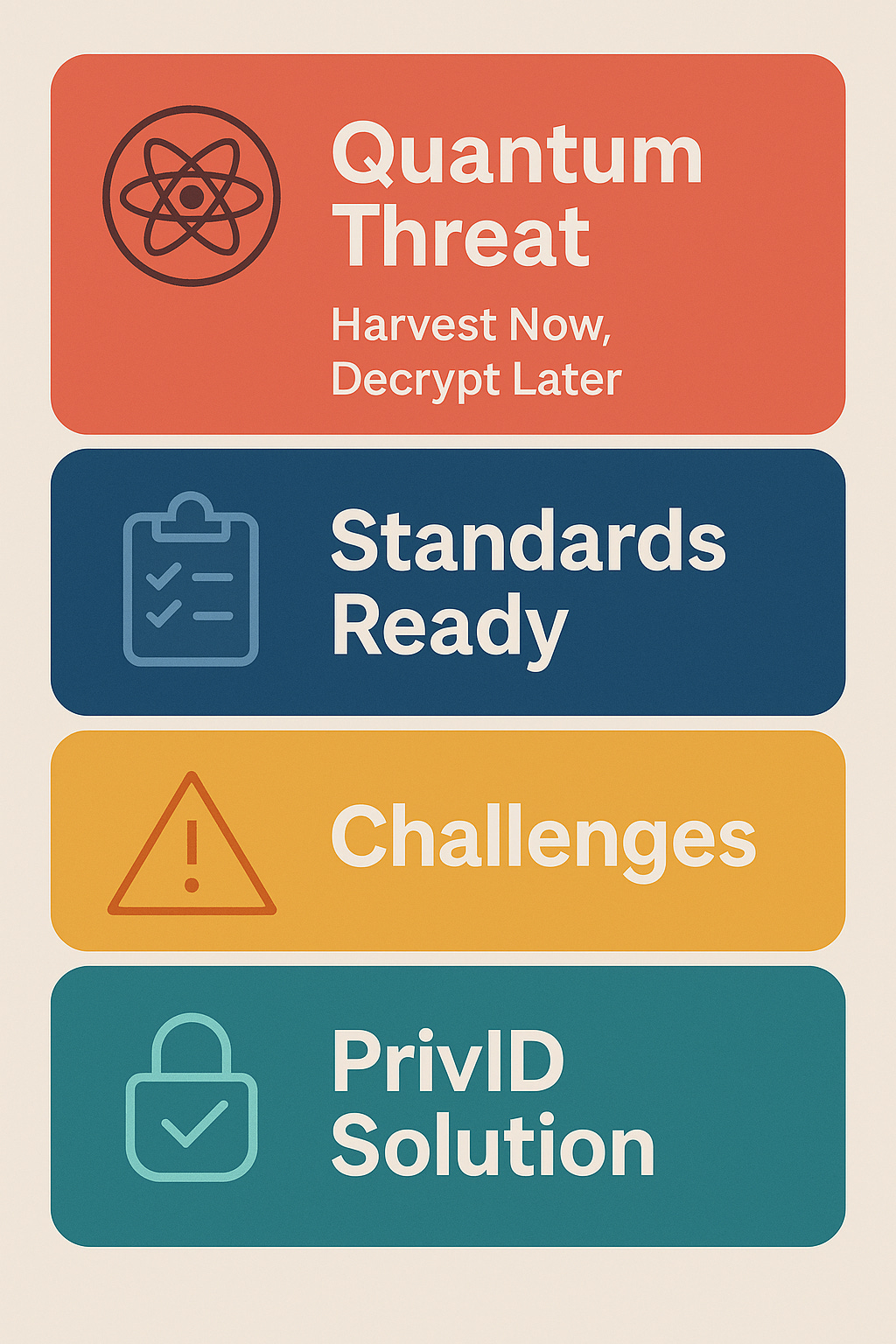
Quantum risk is real: Future quantum computers could crack today’s encryption, so attackers might be quietly harvesting your data now to decrypt later.
Standards are rolling out: NIST-approved post-quantum algorithms are ready, with more to follow by 2026—regulators will expect you to adopt them.
Transition hurdles exist: New algorithms can be larger, slower and require updates to key management and legacy systems.
PrivID simplifies the shift: Our plug-and-play, crypto-agile platform lets you run classical and post-quantum encryption side by side, with minimal performance impact and built-in compliance proofs.
Action plan: Start with a PrivID pilot this quarter, move to hybrid deployment in non-critical systems, and then switch over fully—all on a clear roadmap so you hit standards on time without operational surprises.
Why Post-Quantum Cryptography (PQC) Matters Now
Quantum computers threaten to undo public-key systems like RSA and ECC, which secure everything from e-commerce to VPNs. Even if a workable quantum machine is still years off, adversaries can harvest encrypted traffic today and decrypt it later once quantum tech matures. That “harvest-now, decrypt-later” tactic raises the stakes — delaying your transition isn’t an option.
NIST kicked off its PQC standardisation in 2016, and by August 2024 had finalised three algorithms (CRYSTALS-Kyber, Dilithium, SPHINCS+) for key-encapsulation and signatures nist.govcsrc.nist.gov. Come 2026, more standards (like HQC) will join the list, and compliance deadlines will tighten.
Early Pilots: Proof Is in the Pudding
High-profile firms aren’t waiting. LGT Financial Services and NXP Semiconductors began testing NIST’s new algorithms in their mobile and embedded systems earlier this year, aiming to roll out PQC-backed features by end of 2025 wsj.com. These pilots uncover real-world hurdles: performance hits, interoperability snags and key-management complexities.
Meanwhile, governments (including the U.S. Department of Homeland Security) and industry bodies are publishing roadmaps and guidelines. Gartner even named PQC a top strategic trend for 2025, emphasising “crypto agility” — the ability to swap algorithms quickly as standards evolve secureitconsult.com.
The Challenges of a PQC Roll-Out
Performance and Footprint: Some post-quantum algorithms are larger and slower than their classical counterparts. Poorly optimised implementations can degrade user experience or overload IoT devices.
Interoperability: Legacy systems expect familiar key sizes and formats. Integrating oversized PQC keys often breaks protocols or requires extensive software refactoring.
Key Management: Securely storing and rotating quantum-resistant keys demands updates to HSMs, PKI and certificate lifecycles.
Regulatory Alignment: Different regions may adopt distinct timelines or approved algorithms. Maintaining compliance across jurisdictions adds another layer of complexity.
Given these variables, a piecemeal approach risks costly rework. You need a partner who can guide you end-to-end, from pilot to production.
How PrivID Makes PQC Practical
PrivID’s architecture was built from the ground up on advanced maths — zero-knowledge proofs (ZKP) and fully homomorphic encryption (FHE). Here’s why that matters for your PQC journey:
Algorithm-Agnostic Framework
Our crypto-agile platform lets you plug in new key-encapsulation and signature schemes as standards evolve, without rewriting application code. You can run hybrid hybrids: classical+PQ together, then flip to PQ-only when you’re ready.Minimal Performance Overhead
By offloading heavy maths to our optimised FHE engine and leveraging succinct ZK proofs for key-validity checks, PrivID keeps transaction sizes and latencies low — typically within 5–10% of your current ECC workflows.Seamless Key Management
All keys live in a PrivID-managed vault that supports both classical HSMs and PQ-capable modules. Automated rotation, audit trails and policy-driven access controls ensure you’re always ready for compliance reviews.Proof-Based Compliance Reporting
Need evidence for auditors or regulators? Our ZKP layer can generate tamper-proof proofs that your systems are only using approved PQC algorithms — without revealing any secret keys.Expert Guidance & Integration
PrivID’s cryptographers have decades of collective experience with both classical and emerging schemes. We’ll run interoperability tests, benchmark deployments on your exact stack, and produce a migration roadmap aligned to your risk tolerance and regulatory schedule.
A Phased Roadmap to PQC Readiness
Discovery & Assessment
Inventory cryptographic assets and data flows.
Identify “harvest-now” risks for stored data.
Pilot & Proof-of-Concept
Spin up a PrivID sandbox with selected PQC algorithms.
Test end-to-end integration on representative applications.
Hybrid Deployment
Deploy dual-stack (classical + PQC) in non-critical paths.
Monitor performance, compatibility and user impact.
Full-Scale Roll-Out
Switch primary key-encapsulation to PQC.
Decommission legacy keys according to policy.
Ongoing Optimisation
Swap in new algorithms (e.g. HQC) via our crypto-agile interface.
Update proofs and compliance artefacts automatically.
Why Waiting Isn’t an Option
Attackers are already hoovering up encrypted traffic. Every quarter you delay increases your exposure window. With incoming standards like HQC on track for a draft by late 2026, organisations that start early will enjoy smoother transitions and fewer operational surprises.
PrivID isn’t just another vendor — we’re built on the same cryptographic foundations you need for a post-quantum world. From performance-tuned FHE engines to ZK-driven compliance proofs, we remove the usual friction and make stepping into tomorrow’s encryption standards as straightforward as updating a library.
Ready to see how PrivID can power your PQC journey? Let’s talk roadmaps, benchmarks and pilots — no hyperbole, just real maths solving real problems.