

The Problem’s Always Been There. AI Is Just Showing Us How Big It Is.

Plaintext was already a vulnerability. But AI has made it an industrial-scale amplifier.
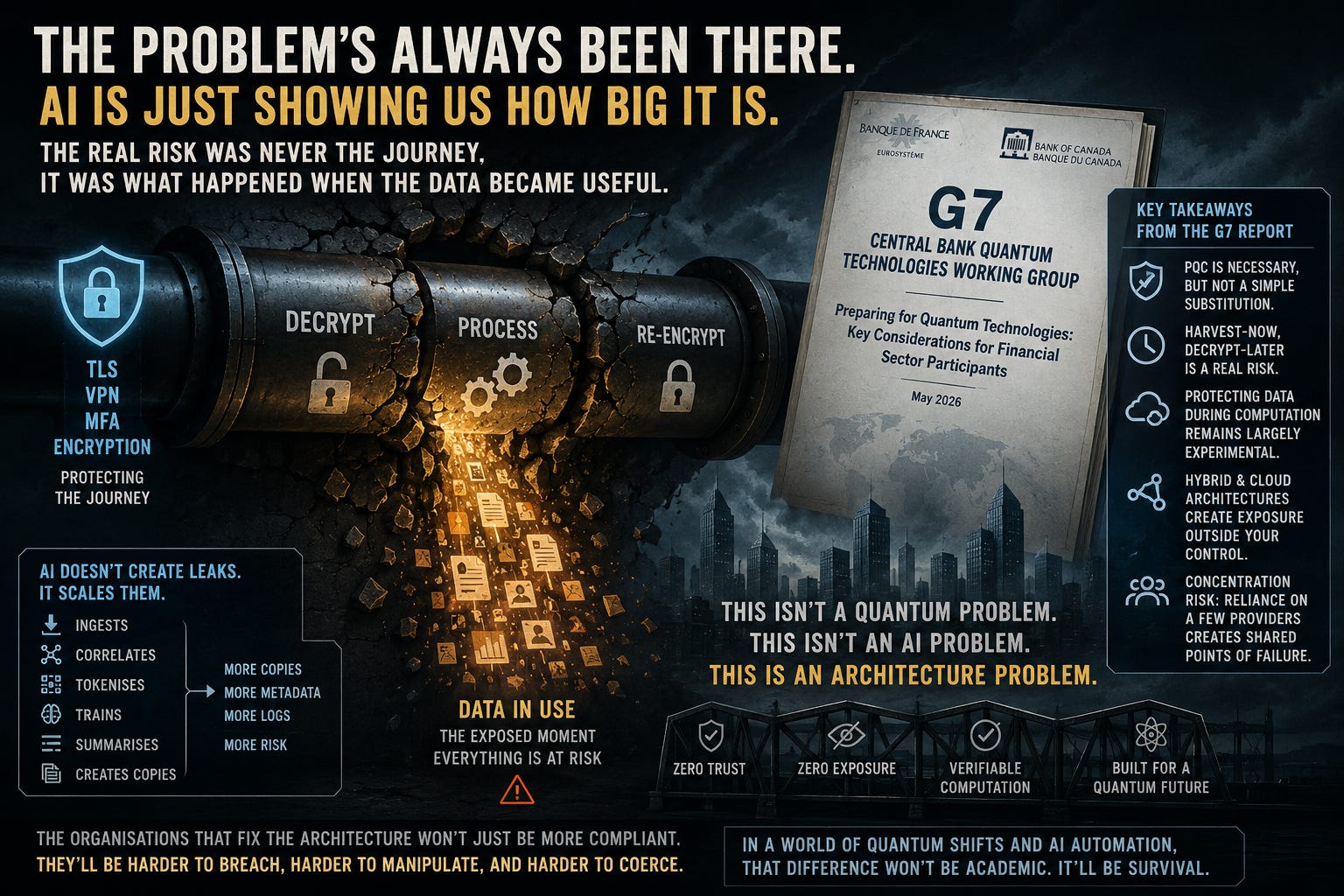
For years, it was the same story:
Buy the platform.
Pass the audit.
Hire the consultants.
Build the SOC.
Renew the licences.
And if something goes wrong? Buy more tooling.
That story made a lot of people rich. It also left one massive problem almost untouched (everyone knew it, they just saw it as the cost of doing business): Sensitive data still becomes exposed the moment it becomes useful.
Not because attackers were brilliant. Not because users clicked the wrong link. Not because your firewall missed something. Because of how the architecture was designed. For decades, we accepted a workflow most people never questioned:
Decrypt.
Process.
Re-encrypt.
I broke this down in more detail in:

because the real vulnerability was never encryption itself. It was the assumption that data had to be exposed in order to be processed.
That became normal and the industry became obsessed with protecting that thinking.
TLS.
VPNs.
MFA.
SSO.
EDR.
SIEM.
That is a lot of acronyms. Some of those tools matter. Some matter a lot. But most of them focus on access, transport, or storage. Very few address what happens when the data actually needs to be used. That’s where the real exposure has always lived. AI is making that impossible to ignore.
AI Didn’t Break Security. It Scaled Its Weaknesses.
AI just exposed an architectural failure that was already there. AI systems don’t just read data.
They ingest it.
Correlate it.
Tokenise it.
Train on it.
Summarise it.
Store derivatives of it.
Every one of those steps increases the attack surface. Every one creates new copies, new metadata, new logs, new models, and new exposure points. So when organisations say: “AI is creating new cybersecurity challenges.” That’s not exactly accurate.
AI is making existing exposure harder to hide. It’s scaling whatever architecture you already built. If your architecture is secure, AI accelerates it. If your architecture leaks, AI industrialises those leaks. That’s the part too many boards, vendors, and executives still don’t want to say out loud.
Even the G7 Is Starting to Say It
Even institutions built around trust, resilience, and systemic stability are now starting to acknowledge something the cybersecurity industry has spent years avoiding.
In May 2026, the G7 Central Bank Quantum Technologies Working Group, co-chaired by the Banque de France and the Bank of Canada, released:
Preparing for Quantum Technologies: Key Considerations for Financial Sector Participants.
The most important part isn’t that the report talks about post-quantum cryptography (PQC). That was expected. The more interesting part is that it doesn’t stop there. Section 1.3, Data Security beyond cryptography, says it out loud: quantum security is not only about encryption and key exchange. It is also about architectures, interfaces, operational models, and where data becomes exposed once systems start doing real work.
Buried beneath the careful institutional language is a point that matters. The report treats quantum migration as more than an algorithm swap. It points to long-term harvest-now, decrypt-later exposure, deep cryptographic dependencies across systems, vendor concentration, third-party risk, and the operational mess of migration. But the part that matters most is the one about protecting data during computation itself. That’s the layer most cybersecurity conversations still glide past.
They talk about protecting data before use. They talk about protecting data after use. They talk about securing the link, the key, the endpoint, and the environment. But the hardest question is what happens during use, when sensitive data has to be processed, analysed, routed, scored, searched, or fed into another system.
It’s saying the quiet part out loud, in carefully crafted language. Stronger cryptography matters. But stronger cryptography, by itself, doesn’t eliminate exposure during processing.
The report also warns that hybrid architectures create multiple points where data may be exposed. That matters because real systems are never just one clean cryptographic layer. They are applications, APIs, logs, cloud services, identity systems, storage, analytics tools, vendors, and “temporary” integrations that somehow become permanent.
This is where technologies like Fully Homomorphic Encryption (FHE) start to matter. Because FHE allows computation to happen while the data is encrypted. The goal is no longer just to secure the key, the link, or the storage layer.
The goal is to remove exposure from the workflow itself. And for some of us, that conversation isn’t theoretical. At PrivID, we’ve spent years building around that exact assumption, combining encrypted computation with proof-based access and verification models (TFHE + ZKP). Not because it sounded cool (although it did), but because the old assumption, that sensitive data must be exposed in order to be useful, stopped making sense a long time ago.
That matters because the G7 isn’t talking about startup hype. They’re talking about the long-term stability of the financial system.
The Problem Was Never Just Encryption
For years, the industry acted as if securing the key meant securing the system. Which isn’t really the case.
You can secure the link.
Authenticate the device.
Rotate the certificates.
Pass every compliance audit.
And the moment your workflow decrypts sensitive data for processing? You’re back to trust. Back to exposure. Back to hoping nobody internal, external, automated, or state-sponsored is watching. That’s not an AI problem. That’s not even a quantum problem. That’s an architecture problem.

Modern cybersecurity rarely eliminates exposure. It just makes it operationally acceptable, until scale makes that compromise impossible to ignore.
Because AI doesn’t wait for governance committees, vendor roadmaps, or five-year transformation plans. It scales whatever you’ve already built.
What Comes Next
The organisations that understand this over the next five years won’t just be more compliant. They’ll be harder to breach. Harder to manipulate. Harder to coerce.
In a world moving toward AI automation, quantum disruption, cloud concentration, and increasingly hostile digital environments. That difference will mean survival.