

The Problem’s Always Been There. AI’s Just Showing How Big It Is.

Before AI (BAI), plaintext was a vulnerability. Post AI (PAI), it’s an amplifier.
Over the last two articles, I’ve argued that the breach problem was never bad luck, and it was never a lack of tooling. It was architecture. Organisations bought the platforms. They passed the audits. They hired the consultants. They built the SOCs and renewed the contracts. The same issue kept surfacing in the exact same place: When the data became useful.
The cycle was almost always the same: Decrypt. Process. Re-encrypt.
Logged. Audited. Documented. And accepted as normal. That didn’t start with AI. That’s the point too many people are still ignoring. The exposure problem didn’t suddenly appear because someone plugged a model into an enterprise workflow. It was alway’s there. AI is forcing organisations to confront just how big that problem actually is.
Before AI
Long before copilots, autonomous agents, and every second vendor adding “AI-powered” to their pitch deck, enterprise systems were already exposing data during processing.
Files were decrypted. Queries were run. Records were analysed. Transactions were enriched. Sensitive information moved between “trusted” systems, “trusted” users, and “trusted” environments. And organisations saw no issue with it.
Not because the model was secure. Because the world around it moved slower. Systems were less interconnected. Data volumes were smaller. Correlation required human effort. Attackers still breached systems. Insiders still leaked data. Architectural weaknesses still existed. But exploiting those weaknesses at scale was harder. The weakness was there. The blast radius was smaller. And that distinction mattered.
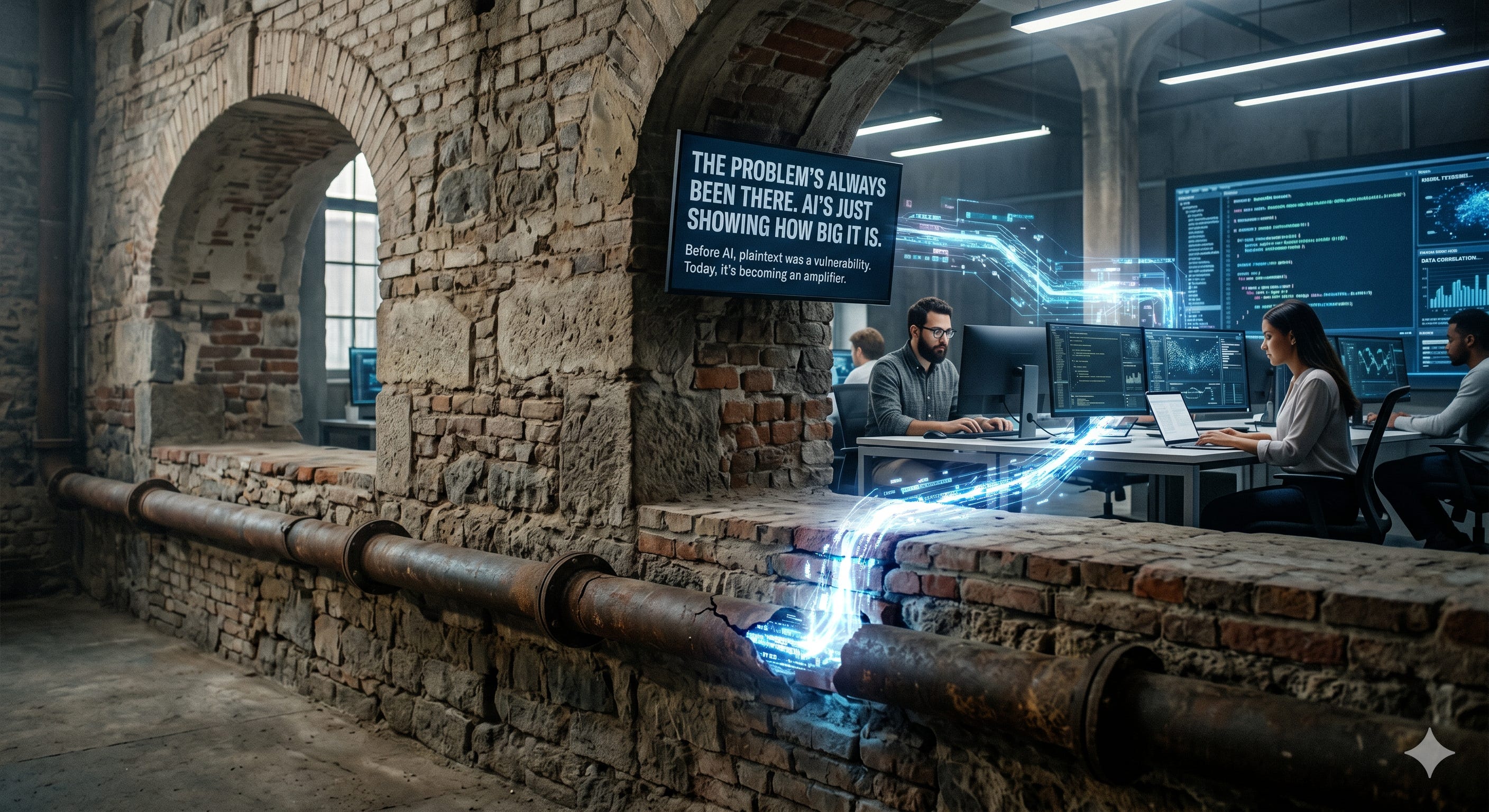
Then the Environment Changed
AI didn’t create a new architectural flaw. It found an old one - and gave it scale. That’s the shift. Every time data becomes exposed now, even for milliseconds, it’s no longer just a moment of operational risk.
It becomes:
A training source for systems it was never meant to feed.
A behavioural fingerprint for social engineering.
A correlation point across disconnected datasets.
A manipulation surface.
A competitive intelligence opportunity.
What once needed teams of analysts, insider access, or months of persistence can now be automated, enriched, correlated, and exploited at machine speed. That changes everything.
Most enterprise security architecture still behaves as though nothing else did. The same trust assumptions. The same “trusted” compute environments. The same decrypt, process, re-encrypt cycle. The same exposure gap. Only now, the environment around that gap has changed completely.
The Real Problem Isn’t AI
This is where the conversation usually goes sideways.
Boards worry about hallucinations.
Compliance teams worry about governance.
Vendors talk about ethics, explainability, and model drift.
Those conversations matter. But they aren’t the deeper issue. The deeper issue is this:
AI exposed how much modern enterprise architecture still depend on that weakness.
Organisations are now trying to deploy post-AI workflows... On top of pre-AI security assumptions. That mismatch is no longer theoretical. It’s showing up:
In healthcare.
In finance.
In defence.
In critical infrastructure.
Anywhere sensitive data still has to become exposed in order to become useful. This leaves a last question that no one wants to ask:
What happens when data no longer needs to be exposed at all?